Fueling
Carb loading for a marathon, 70.3 or Ironman
Carb loading for a marathon, 70.3 or Ironman: 10 to 12 g/kg a day for 36 to 48 hours, how to cut fiber, who benefits, and an example 2-day loading plan.

To carb load for a marathon, 70.3 or Ironman, eat about 10 to 12 g of carbohydrate per kg of body mass per day for the 36 to 48 hours before the race while tapering your training [1]. You do not need the old depletion phase, and loading is worth doing for events lasting longer than about 90 minutes, where it can delay fatigue and improve finishing time by a few percent [2]. Cut fiber and fat during the load so the volume of carbohydrate is easier on your gut [1].
What does carb loading actually do?
Carb loading raises muscle glycogen above normal resting levels. A review of the performance research found that higher starting glycogen postpones fatigue by about 20% in endurance exercise lasting more than 90 minutes, and improves performance by about 2 to 3% in events where a set distance is covered as fast as possible [2]. The same review found little or no benefit for moderate-intensity running or cycling lasting 60 to 90 minutes, because substantial glycogen remains in the muscles at the end of those efforts [2].
Field data from marathon runners fit this picture. In an observational study of 257 London Marathon runners, those who ate more than 7 g/kg of carbohydrate the day before the race ran faster overall and held their pace better than those who ate less than 7 g/kg [3]. That design cannot prove cause and effect.

How many grams of carbs per kg should you eat to carb load?
The ACSM, Academy of Nutrition and Dietetics and Dietitians of Canada joint position paper gives these acute fueling targets [1]:
The ISSN nutrient timing position stand gives a similar range, stating that glycogen stores are maximized by a high-carbohydrate diet of 8 to 12 g/kg/day [4].
For a 70 kg athlete, 10 to 12 g/kg is about 700 to 840 g of carbohydrate per day, which is why fiber and fat need to come down.
How many days should you carb load?
The guideline is 36 to 48 hours [1]. You do not need a week.
The classic protocol added a depletion phase: several days of very low carbohydrate intake with depleting exercise before the high-carbohydrate days. A 1981 study in trained runners compared 3 days at 15% carbohydrate followed by 3 days at 70% with a moderate version of 3 days at 50% followed by 3 days at 70%. Both raised muscle glycogen to essentially the same level (207 vs 203 mmol glucosyl units/kg wet muscle) [5]. That study also found no performance difference in a 20.9 km run, which fits the finding that loading matters for longer events [2, 5].
Loading may be possible even faster. In 8 endurance-trained men who stayed physically inactive, eating 10 g/kg/day of high-GI carbohydrate raised muscle glycogen from about 95 to 180 mmol/kg wet weight after 1 day, with no further rise on days 2 and 3 [6]. That is a small study in men only, so the 36 to 48 hour window in the guideline remains the safer default, especially if you are still doing some light training.
Does carb loading work for women?
Yes, provided total energy intake rises enough. In one study, female endurance athletes who increased carbohydrate from 55 to 60% to 75% of energy for 4 days did not increase muscle glycogen, while men did [7]. A follow-up found that women did increase glycogen when total energy and carbohydrate intake were both raised, suggesting the earlier result reflected low energy intake rather than a sex difference in storage capacity [8]. A review by the same lead author reported that women showed similar increases to men when they ate more than 8 g/kg/day [9].
Plan the load in g/kg, not as a percentage of your normal diet.
Should you eat low fiber when carb loading?
For most athletes, yes. The position paper notes that athletes fueling up for an event may choose carbohydrate sources that are low in fiber and residue and easy to eat, to meet fuel targets and for gut comfort [1]. It also notes that very low fat intakes are acceptable for short periods such as carb loading [1].
Fiber is worth controlling for race-day comfort too. In a survey of 55 male triathletes, all of those who reported intestinal cramps during a half-Ironman had eaten fiber-rich foods in the pre-race meal, compared with 10% of those without cramps [10].
Does glycemic index matter when carb loading?
Less than total amount. High-GI foods may store glycogen somewhat faster. In 5 well-trained cyclists eating 10 g/kg over 24 hours after glycogen-depleting exercise, muscle glycogen rose by 106 mmol/kg wet weight on a high-GI diet compared with 71.5 mmol/kg on a low-GI diet [11]. That is a small study of post-exercise recovery rather than a pre-race load, so treat it as supportive rather than decisive. The fast 1-day loading study also used high-GI foods [6]. In practice, refined, low-fiber starches tend to suit both goals: they are easy to eat in volume and gentle on the gut.
Will carb loading make you heavier?
Expect the scale to go up. Each gram of glycogen is stored in muscle with at least about 3 g of water [12], so body mass rises when glycogen rises. That is stored fuel and water, not fat.
Who should carb load, and who should not bother?
For Ironman and 70.3, loading is only half of the job. Carbohydrate intake during the race matters as well, with the position paper suggesting up to 90 g/h for events over 2.5 to 3 hours [1]. See how many carbs per hour on the bike.
If you have diabetes or another medical condition, or a history of disordered eating, plan any carb load with your doctor or a registered dietitian.
Example 2-day carb loading plan (70 kg athlete)
This is an example, not a prescription. Target: 10 to 12 g/kg, about 700 to 840 g of carbohydrate per day, spread across 6 to 8 eating occasions, with moderate protein and lower fat. Check amounts against package labels or a food database, and rehearse the plan before a long training session.
Breakfast: white bagel or white toast with jam and honey, a bowl of rice porridge or white rice cereal with milk, a glass of fruit juice.
Mid-morning: a ripe banana, a few rice cakes with honey.
Lunch: a large plate of white rice or white pasta with a simple tomato sauce and a modest portion of chicken, fish or eggs.
Afternoon: fruit juice or a sports drink, a white roll with jam, a low-fat yogurt.
Dinner: a large serving of white rice, white pasta or peeled potatoes, a modest portion of lean protein, a small portion of well-cooked vegetables.
Evening snack: pancakes or a white roll with syrup or honey, or a bowl of low-fiber cereal with milk.
Avoid relying on one big pasta dinner, rich cream or cheese sauces, large salads, whole grains and legumes, and any food you have not tested.

On race morning, eat 1 to 4 g/kg of carbohydrate 1 to 4 hours before the start [1]. See what to eat before a long ride or long run for the details.
How reload handles this
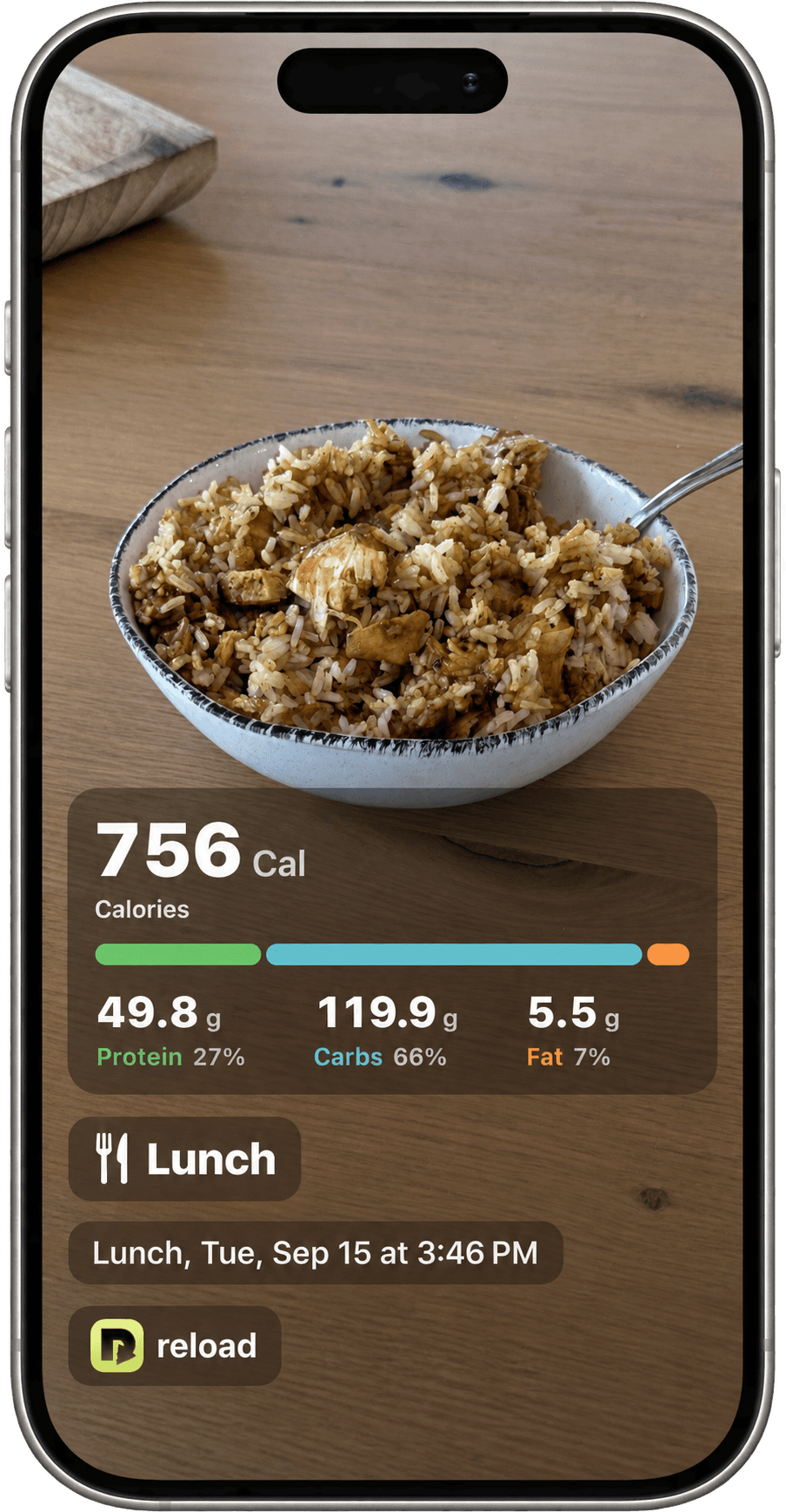
reload reads the training you have planned as well as the training you have done, and sets daily calorie, protein, carbohydrate and fat targets from it, so a long ride day and a rest day get different targets. Each macro gets a target range, and the app shows how the day’s targets were built. The fuel tank is an estimate of stored glycogen from training load and food intake, shown as Topped up, Adequate, Underfueled or On reserve. It is a model estimate, not a measurement of your muscle glycogen. Food logging uses search and barcode scanning. reload Max turns a photo or a short description into calories, protein, carbs and fat, and shows every portion so you can adjust it before saving. See /pricing.





FAQ
How many days before a marathon should I start carb loading?
Start 36 to 48 hours before the race, with 10 to 12 g/kg of carbohydrate per day [1]. A week-long load or a depletion phase is not needed [5].
Is a big pasta dinner the night before enough?
Usually not. One meal rarely reaches 10 to 12 g/kg for the day, and the guideline is a full 36 to 48 hours of high intake [1].
Should I carb load for a half marathon?
Only if you expect to run for longer than about 90 minutes. Below that, the guideline is general fueling up at 7 to 12 g/kg in the 24 hours before [1, 2].
Scientific references12 sources, cited in the text as [1], [2] and so on
- 1Thomas DT, Erdman KA, Burke LM. 2016. Nutrition and Athletic Performance: joint position paper of the Academy of Nutrition and Dietetics, Dietitians of Canada, and the American College of Sports Medicine. Medicine & Science in Sports & Exercise 48(3):543-568. Full text via Dietitians of Canada: dietitians.ca/DietitiansOfCanada/media/Documents/Resources/noap-position-paper.pdf (DOI: doi.org/10.1249/MSS.0000000000000852)
- 2Hawley JA, Schabort EJ, Noakes TD, Dennis SC. 1997. Carbohydrate-loading and exercise performance. An update. Sports Medicine. doi.org/10.2165/00007256-199724020-00001
- 3Atkinson G, Taylor CE, Morgan N, Ormond LR, Wallis GA. 2011. Pre-race dietary carbohydrate intake can independently influence sub-elite marathon running performance. International Journal of Sports Medicine. doi.org/10.1055/s-0031-1273739
- 4Kerksick CM, Arent S, Schoenfeld BJ, et al. 2017. International society of sports nutrition position stand: nutrient timing. Journal of the International Society of Sports Nutrition. doi.org/10.1186/s12970-017-0189-4
- 5Sherman WM, Costill DL, Fink WJ, Miller JM. 1981. Effect of exercise-diet manipulation on muscle glycogen and its subsequent utilization during performance. International Journal of Sports Medicine. doi.org/10.1055/s-2008-1034594
- 6Bussau VA, Fairchild TJ, Rao A, Steele P, Fournier PA. 2002. Carbohydrate loading in human muscle: an improved 1 day protocol. European Journal of Applied Physiology. doi.org/10.1007/s00421-002-0621-5
- 7Tarnopolsky MA, Atkinson SA, Phillips SM, MacDougall JD. 1995. Carbohydrate loading and metabolism during exercise in men and women. Journal of Applied Physiology. doi.org/10.1152/jappl.1995.78.4.1360
- 8Tarnopolsky MA, Zawada C, Richmond LB, et al. 2001. Gender differences in carbohydrate loading are related to energy intake. Journal of Applied Physiology. doi.org/10.1152/jappl.2001.91.1.225
- 9Tarnopolsky MA. 2000. Gender differences in metabolism; nutrition and supplements. Journal of Science and Medicine in Sport. doi.org/10.1016/s1440-2440(00)80038-9
- 10Rehrer NJ, van Kemenade M, Meester W, Brouns F, Saris WH. 1992. Gastrointestinal complaints in relation to dietary intake in triathletes. International Journal of Sport Nutrition. doi.org/10.1123/ijsn.2.1.48
- 11Burke LM, Collier GR, Hargreaves M. 1993. Muscle glycogen storage after prolonged exercise: effect of the glycemic index of carbohydrate feedings. Journal of Applied Physiology. doi.org/10.1152/jappl.1993.75.2.1019
- 12Fernández-Elías VE, Ortega JF, Nelson RK, Mora-Rodriguez R. 2015. Relationship between muscle water and glycogen recovery after prolonged exercise in the heat in humans. European Journal of Applied Physiology. doi.org/10.1007/s00421-015-3175-z

Live now on iPhone.
Choose your plan, check out on the web and get reload on your iPhone today. Android is coming to Google Play next, so join the Android list and you’ll be the first to know when it lands.

