Fueling
Glycogen explained: how much you store, how fast it goes
How much glycogen can you store? Muscle and liver amounts, how fast endurance training uses it, how fast it comes back, and why it is hard to measure.

A typical adult stores roughly 500 g of glycogen, about 400 g in skeletal muscle and about 100 g in the liver, and the total varies widely with body size, diet, fitness and recent exercise [1][2]. How fast you use it depends mainly on exercise intensity and duration [1][3]. After a large depletion, full muscle restoration can take close to 24 hours of high carbohydrate intake [2].
How much glycogen do you store?
Glycogen is stored with water: at least 3 g per gram according to one review [2], and about 3 to 4 g in human studies according to another, which notes the relationship is not settled [4]. This is why body mass often rises after carbohydrate loading.
What do muscle glycogen concentrations look like?
Researchers report muscle glycogen per kilogram of muscle because they measure it in small biopsy samples. Values are given per kg of dry mass (dm) or wet weight (ww). Dry-weight values are about 4.3 times wet-weight values [2].
Rested, normal diet. A meta-analysis of 181 studies estimated resting vastus lateralis glycogen at 462 ± 132 mmol/kg dm in males with normal carbohydrate availability and an average VO2max of 53 mL/kg/min [3].
After high carbohydrate intake. High carbohydrate availability (at least 6 g/kg/day for 3 days or more, or at least 7 g/kg/day for 2 days or more) added about 102 mmol/kg dm [3].
After depletion and a low-carbohydrate diet. Low availability reduced resting glycogen by about 253 mmol/kg dm [3].
In wet-weight terms, trained and well-fed endurance athletes typically sit around 150 mmol/kg ww after 8 to 12 hours of rest. Highly fit athletes can reach about 200 mmol/kg ww after a few days of high carbohydrate intake, and prolonged intense exercise can bring stores below 50 mmol/kg ww [2]. Across all conditions, reported values span about 50 to 800 mmol/kg dm [1].
Where inside the muscle is it stored?
About 75 percent lies between the myofibrils, 5 to 15 percent within them and 5 to 15 percent beneath the cell membrane. The pool within the myofibrils appears to be used preferentially, and its depletion likely contributes to fatigue [1][2].

How fast do you use glycogen during exercise?
Intensity is the main driver. As exercise intensity rises from moderate (about 65 percent of VO2max) to high (about 85 percent), muscle glycogen breakdown, liver glycogen breakdown and blood glucose uptake all increase [1]. The meta-analysis put numbers on this [3]:
Raising intensity by 30 percent of VO2max increased glycogen use by 87 to 134 mmol/kg dm at every timepoint after the first 5 minutes.
Starting with 200 mmol/kg dm more glycogen increased glycogen use, moderately so by about 2 hours and at fatigue.
Running used about 70 mmol/kg dm less glycogen than cycling in the vastus lateralis.
Real rides show how large the drop can be:
Does eating during exercise spare glycogen?
In the Gonzalez study above, ingesting glucose or sucrose at 1.7 g/min prevented liver glycogen depletion but did not prevent muscle glycogen depletion [6]. A review of liver glycogen concluded that ingesting carbohydrate at more than 1.5 g/min can prevent liver glycogen depletion during moderate-intensity exercise [7]. Exogenous carbohydrate oxidation can reach about 1.8 g/min when fructose or sucrose is added to glucose [1]. For practical intake targets, see how many carbs per hour on the bike.
How fast does glycogen come back after training?
Muscle glycogen restoration is biphasic. A rapid phase occurs soon after exercise, followed by a slower, insulin-dependent phase that can continue for days when carbohydrate intake stays high [2][8].
What this means in practice:
Small depletion. If glycogen fell by about 40 mmol/kg ww and you eat carbohydrate promptly and at 30-minute intervals, full restoration might take 4 to 5 hours [2].
Large depletion. After a fall of about 150 mmol/kg ww, full restoration might need close to 24 hours [2].
24-hour turnaround. About 10 g/kg/day, with enough total energy, maximizes restoration. Intakes above 10 g/kg/day appear to add nothing [2]. In one study, 24 hours at 9.8 g/kg/day restored 93 percent of the glycogen used in a 2-hour ride at 65 percent of VO2max, while 1.9 g/kg/day restored 13 percent [2].
Energy intake matters. Even with adequate carbohydrate, restoration is incomplete if total energy intake is too low [2].
Early recovery. In the first 0 to 4 hours, carbohydrate of about 1 g/kg body mass optimizes resynthesis [8]. Over 4 to 24 hours, total intake matters more than type, form or timing, and adding protein can help when carbohydrate intake is suboptimal [8].
Liver. Combining glucose with fructose or galactose can double post-exercise liver glycogen repletion rates [7].
Muscle damage can slow muscle glycogen resynthesis [2].
See also rest day vs long ride day nutrition and carb loading.

Why can’t you measure glycogen in the field?
Assessing muscle glycogen in the field is impractical [3]. Each method has a trade-off:
Muscle biopsy. The reference method. A needle removes about 20 to 100 mg of muscle, usually from the vastus lateralis [4]. It is invasive and commonly leaves local soreness and stiffness for 2 to 3 days [9], and it samples one site in one muscle.
13C magnetic resonance spectroscopy. Non-invasive and repeatable, with values that overlap biopsy results. Repeat measurements vary by 3.5 to 10 percent, and it needs specialized hardware in an MRI facility [4][9].
Ultrasound. A 2015 study reported a strong correlation (r = 0.92) between ultrasound score changes and biopsy glycogen changes after a 75 km time trial [5]. Later studies from independent groups reported discrepant results, and a 2021 review judged the evidence for validity “at best equivocal” [10].
Bioimpedance. Electrical resistance may shift with glycogen loading, but a direct relationship has not been established [4].
Any glycogen figure in an app is therefore a model estimate built from training and food data, not a measurement.
What does this mean for your training?
Researchers have proposed matching carbohydrate availability to the demands of each session, called “fuel for the work required” [11]. Stores do not need to be full for every session. In one 7-day study, 5 g/kg/day let muscle glycogen fall 30 to 36 percent without impairing training capacity, while low-carbohydrate diets do impair performance [2]. Long or intense sessions draw glycogen down the most, so those are the ones to fuel before, during and after. See also signs you are under-fueling your training.
How reload handles this
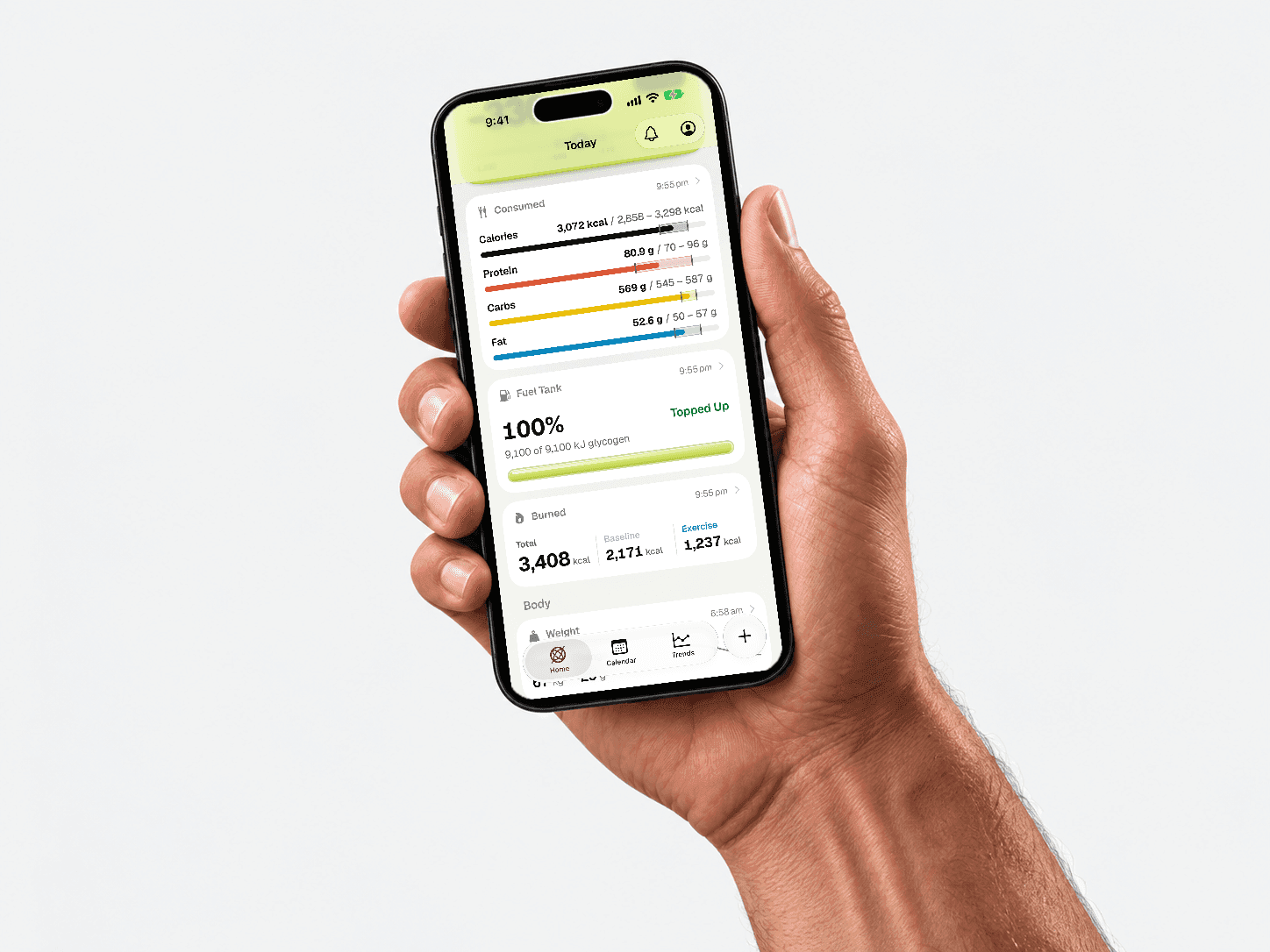
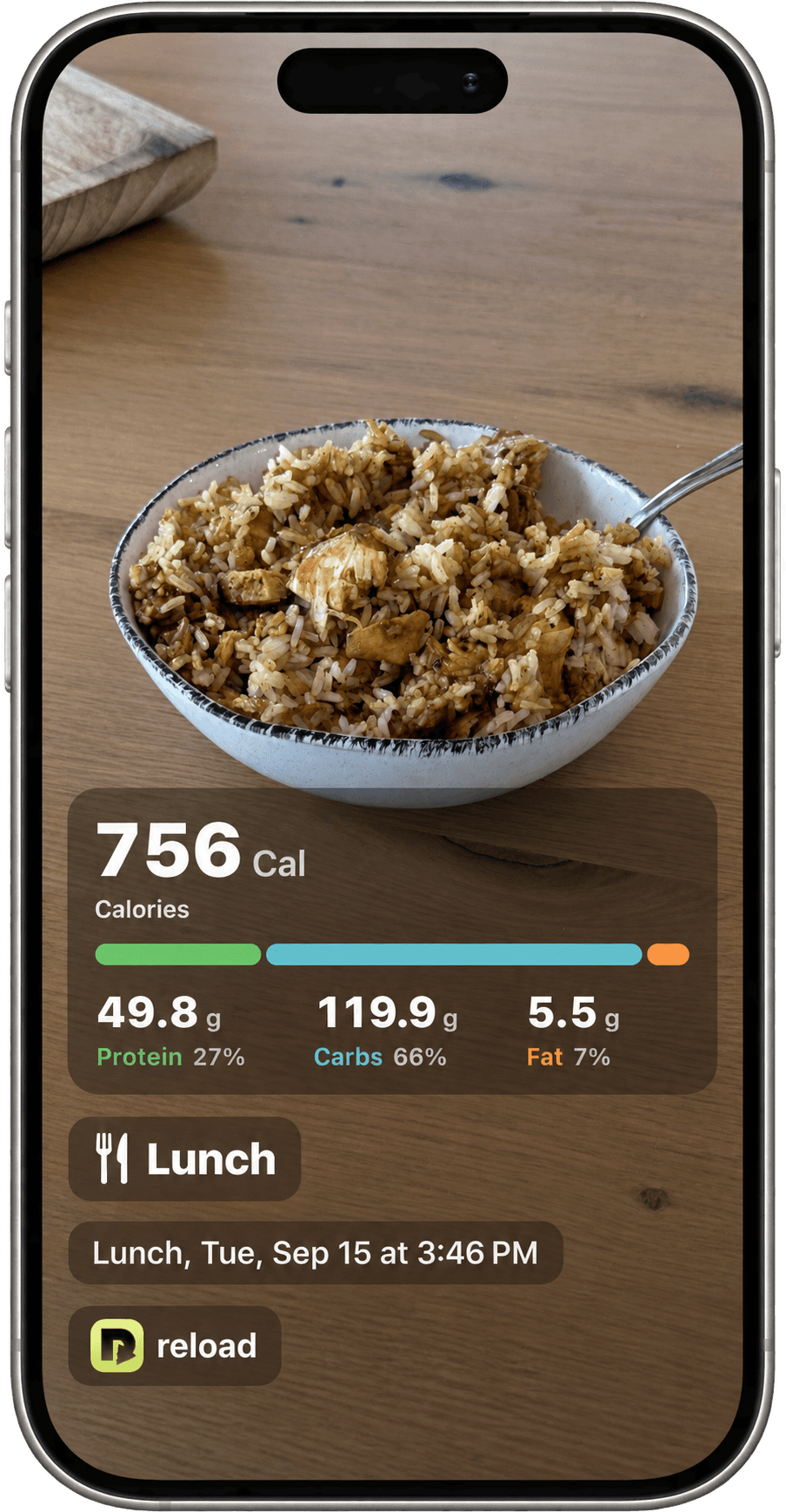
reload reads the training you have done and the training you have planned and sets daily calorie, protein, carbohydrate and fat targets, so a long ride day and a rest day get different targets. The fuel tank is an estimate of stored glycogen built from your training load and food intake. It is shown as Topped up, Adequate, Underfueled or On reserve. It is a model estimate, not a measurement, for the reasons above. Food logging includes search and barcode scanning. reload Max turns a photo or a short description into calories, protein, carbs and fat, and shows every portion so you can adjust it before saving. See plans and pricing.





FAQ
How long does it take to deplete glycogen?
It depends on intensity, starting level and duration. In one study, trained cyclists used about 77 percent of the glycogen in the sampled thigh muscle (vastus lateralis) in a 75 km time trial lasting about 2.8 hours [5].
How long does it take to refill glycogen?
A small depletion can be restored in about 4 to 5 hours with prompt, repeated carbohydrate intake. A large depletion may need close to 24 hours [2].
Does fasting empty my muscle glycogen?
Short-term fasting does not appear to affect muscle glycogen, but liver glycogen falls overnight and is restored by a pre-exercise meal [1][2].
Can a wearable measure my glycogen?
No current consumer device has been validated to measure muscle glycogen. Field estimates come from models of training and intake [3][4][10].
Scientific references11 sources, cited in the text as [1], [2] and so on
- 1Hearris MA, Hammond KM, Fell JM, Morton JP, 2018, Regulation of Muscle Glycogen Metabolism during Exercise: Implications for Endurance Performance and Training Adaptations, Nutrients, doi.org/10.3390/nu10030298
- 2Murray B, Rosenbloom C, 2018, Fundamentals of glycogen metabolism for coaches and athletes, Nutrition Reviews, doi.org/10.1093/nutrit/nuy001
- 3Areta JL, Hopkins WG, 2018, Skeletal Muscle Glycogen Content at Rest and During Endurance Exercise in Humans: A Meta-Analysis, Sports Medicine, doi.org/10.1007/s40279-018-0941-1
- 4Shiose K, Takahashi H, Yamada Y, 2022, Muscle Glycogen Assessment and Relationship with Body Hydration Status: A Narrative Review, Nutrients, doi.org/10.3390/nu15010155
- 5Nieman DC, Shanely RA, Zwetsloot KA, Meaney MP, Farris GE, 2015, Ultrasonic assessment of exercise-induced change in skeletal muscle glycogen content, BMC Sports Science, Medicine and Rehabilitation, doi.org/10.1186/s13102-015-0003-z
- 6Gonzalez JT, Fuchs CJ, Smith FE, et al., 2015, Ingestion of glucose or sucrose prevents liver but not muscle glycogen depletion during prolonged endurance-type exercise in trained cyclists, American Journal of Physiology: Endocrinology and Metabolism, doi.org/10.1152/ajpendo.00376.2015
- 7Gonzalez JT, Fuchs CJ, Betts JA, van Loon LJC, 2016, Liver glycogen metabolism during and after prolonged endurance-type exercise, American Journal of Physiology: Endocrinology and Metabolism, doi.org/10.1152/ajpendo.00232.2016
- 8Burke LM, van Loon LJC, Hawley JA, 2017, Postexercise muscle glycogen resynthesis in humans, Journal of Applied Physiology, doi.org/10.1152/japplphysiol.00860.2016
- 9Greene J, Louis J, Korostynska O, Mason A, 2017, State-of-the-Art Methods for Skeletal Muscle Glycogen Analysis in Athletes: The Need for Novel Non-Invasive Techniques, Biosensors, doi.org/10.3390/bios7010011
- 10Bone JL, Ross ML, Tomcik KA, et al., 2021, The Validity of Ultrasound Technology in Providing an Indirect Estimate of Muscle Glycogen Concentrations Is Equivocal, Nutrients, doi.org/10.3390/nu13072371
- 11Impey SG, Hearris MA, Hammond KM, et al., 2018, Fuel for the Work Required: A Theoretical Framework for Carbohydrate Periodization and the Glycogen Threshold Hypothesis, Sports Medicine, doi.org/10.1007/s40279-018-0867-7

Live now on iPhone.
Choose your plan, check out on the web and get reload on your iPhone today. Android is coming to Google Play next, so join the Android list and you’ll be the first to know when it lands.

