Fueling
Rest day vs training day nutrition for endurance athletes
Rest day vs training day nutrition for endurance athletes: carbs in g/kg for each day type, why protein stays steady, and example days for a 70 kg rider.

On a rest day, most endurance athletes should eat noticeably less carbohydrate than on a long ride day, keep protein about the same, and keep fat at a normal level. Sports nutrition guidelines give about 3 to 5 g of carbohydrate per kg of body mass for light training days, rising to 6 to 10 g/kg for 1 to 3 hours of endurance training and 8 to 12 g/kg for 4 to 5 hours or more, while protein sits at about 1.2 to 2.0 g/kg every day [1]. The point is to match fuel to the work, not to eat the same thing every day.
Why should rest day and long ride day nutrition differ?
Carbohydrate is the fuel that changes most with training load. Muscle glycogen is used heavily during long or hard sessions, and the main job of carbohydrate on the following hours and days is to restore it in proportion to what the next session needs [2]. Researchers at Liverpool John Moores University describe this as “fuel for the work required”: carbohydrate availability is adjusted to the demands of the upcoming session or sessions, rather than kept high or low all the time [3].
Protein is different. The anabolic effect of exercise lasts at least 24 hours [4], so the day after a big ride is still a repair day. An indicator amino acid oxidation (IAAO) study in endurance-trained men measured 24 hours after exercise estimated an average protein requirement of 2.1 g/kg/day, with an upper 95% confidence limit of 2.6 g/kg/day [5]. That was a small study of 8 men, so treat it as a signal that protein needs do not drop to sedentary levels on a rest day, not as a universal target.

How many carbs on a rest day vs a training day?
The ACSM, Academy of Nutrition and Dietetics and Dietitians of Canada joint position paper gives daily carbohydrate ranges by training load [1]. No position stand gives a separate number for a full rest day. The closest reference is the light-load band.
All values from [1]. The paper advises against chronic fat intakes below 20% of energy because of the risk to essential fatty acid and fat-soluble vitamin intake [1]. Where you sit inside each band depends on intensity, hours trained and what is planned for tomorrow.
Should you cut carbs on a rest day?
Lower, yes. Close to zero, no, for most athletes. Three reasons:
Glycogen restoration continues. After the early recovery window (0 to 4 hours), glycogen storage over the following 4 to 24 hours is driven mainly by total carbohydrate intake, and that intake should meet the fuel needs of the next session [2].
Tomorrow matters. If the rest day is the day before a long ride or a race, it is a refuelling day, not a low day. See carb loading for a marathon, 70.3 or Ironman for event preparation.
Low energy and low carbohydrate availability carry risk. The 2023 IOC consensus on Relative Energy Deficiency in Sport (REDs) highlights a growing role of low carbohydrate availability in the syndrome, alongside low energy availability [6]. The joint position paper notes that energy availability of about 45 kcal/kg of fat-free mass per day is associated with energy balance and optimal health in women, and that chronic intakes below 30 kcal/kg fat-free mass per day are associated with impaired body function [1]. These thresholds come mostly from research in women and are guides, not hard cutoffs.
If you are deliberately using lower-carbohydrate days as part of a “train low” strategy, that is a planned tool used on selected sessions, not a default for every rest day [3]. If you want to build a calorie deficit for body composition, read how to lose weight during a training block without hurting performance first.
Do you need less protein on a rest day?
Usually not much less. The position paper range of 1.2 to 2.0 g/kg/day [1] applies across the week, and the ISSN recommends spreading protein in doses of about 0.25 g/kg or 20 to 40 g every 3 to 4 hours [4]. See how much protein endurance athletes need.
What does a long ride day look like compared with a rest day?
The examples below are for a 70 kg cyclist. They are worked examples using the ranges above, not personal prescriptions.
Example: rest day (70 kg)
Carbohydrate at 3 to 5 g/kg: about 210 to 350 g
Protein at 1.2 to 2.0 g/kg: about 84 to 140 g
Fat: at least 20% of total energy
Sample meals (example only):
Breakfast: oats cooked in milk, a sliced banana, plain yogurt.
Lunch: whole-grain bread sandwich with chicken or eggs, salad, a piece of fruit.
Snack: yogurt or cottage cheese with berries.
Dinner: salmon or tofu, roasted potatoes, plenty of vegetables, olive oil.
Evening: a glass of milk or a yogurt if protein is short for the day.
Example: 4-hour endurance ride (70 kg)
Carbohydrate at 8 to 10 g/kg: about 560 to 700 g (a 4-hour day sits between the high and very high bands in [1])
Of that, carbohydrate during the ride: the position paper suggests 30 to 60 g/h for 1 to 2.5 hours and up to 90 g/h for sessions over 2.5 to 3 hours [1]. At 60 to 90 g/h for 4 hours, that is about 240 to 360 g on the bike.
Protein: about 84 to 140 g, the same range as the rest day
Fat: at least 20% of energy [1]
Sample meals (example only):
Pre-ride breakfast: white bagel or toast with jam or honey, banana, a small portion of yogurt. See what to eat before a long ride or long run.
On the bike: rice cakes, bananas, a sports drink or other carbohydrate you have practiced with. See how many carbs per hour on the bike.
Post-ride: a carbohydrate-rich meal with a protein source. With a full day before the next session, total carbohydrate over the next 24 hours matters more than precise timing [2]. If the next hard session is less than 8 hours away, the position paper gives 1 to 1.2 g/kg per hour for the first 4 hours [1].
Dinner: a large serving of rice or pasta, lean meat, fish, eggs or tofu, cooked vegetables.
The practical difference between the two days is mostly the starch portions and the on-bike fuel. Protein and vegetables stay roughly constant.

How do you plan the week?
A simple approach that follows the “fuel for the work required” idea [3]:
Look at tomorrow, not just today. The day before a key session should not be your lowest-carbohydrate day.
Put the biggest carbohydrate intake around the longest and hardest sessions.
Hold protein near the same daily target.
Watch for signs that intake is too low overall. See signs you are under-fueling your training.
Daily energy expenditure is always an estimate. See how many calories you burn cycling, running and swimming.
If you have a medical condition or a history of disordered eating, talk to a doctor or registered dietitian before changing how you periodize food.
How reload handles this
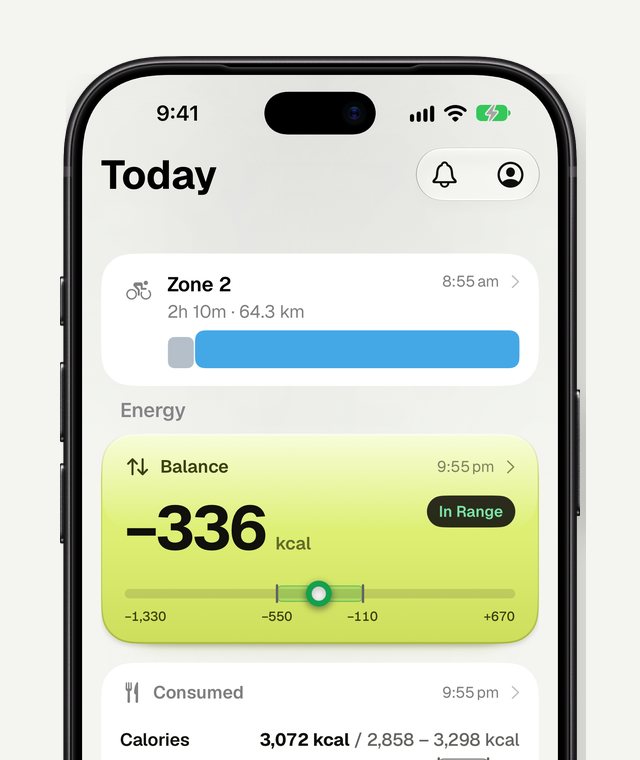
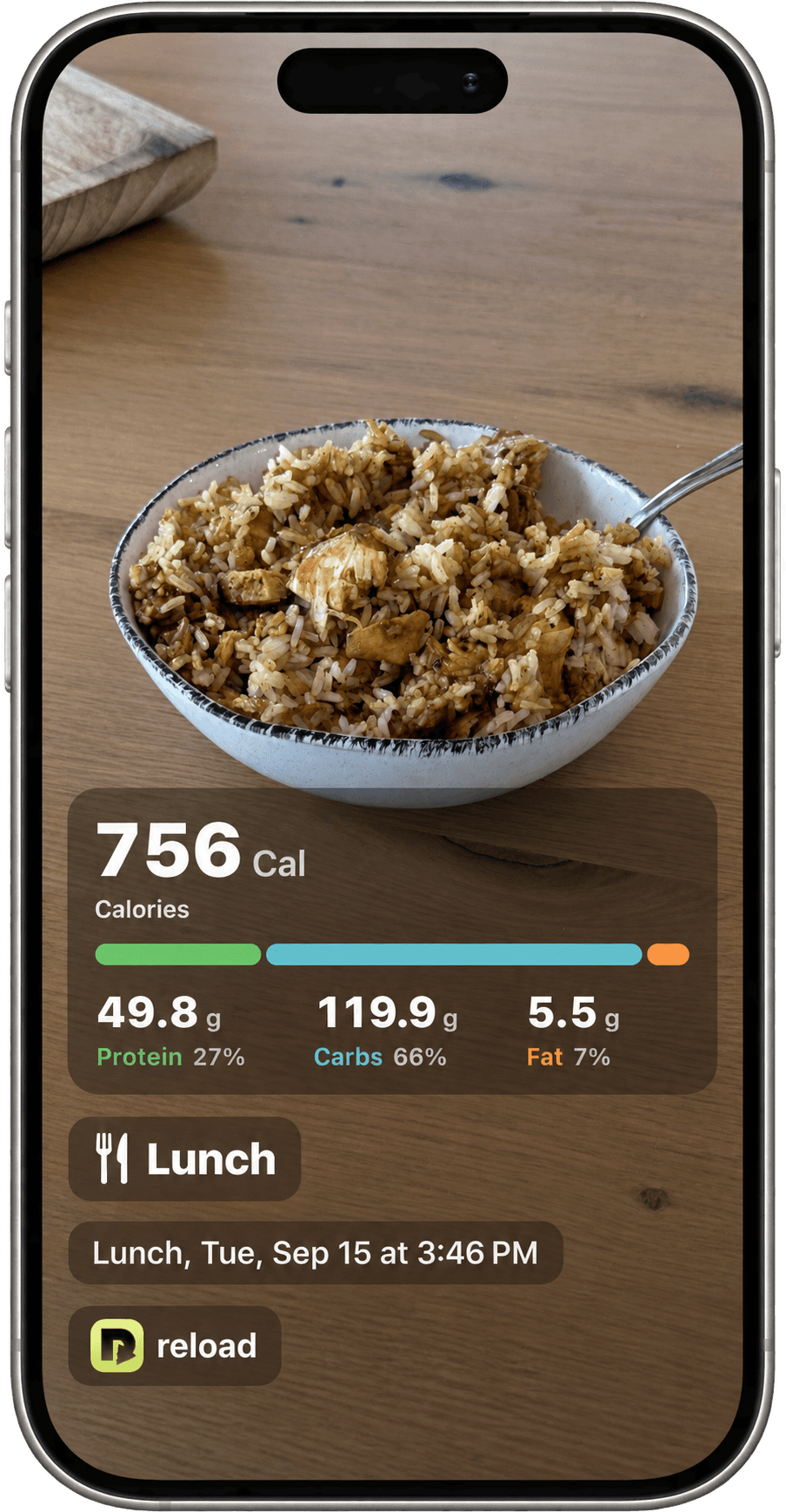
reload is a calorie and macro tracker built for endurance athletes. It reads the training you have done and the training you have planned, and sets daily calorie, protein, carbohydrate and fat targets, so a long ride day and a rest day get different targets. Protein, carbs and fat each get a target range rather than a single number, and the app shows how each day’s targets were built. Energy burned is split into resting and active. The fuel tank gives an estimate of stored glycogen from training load and food intake, shown as Topped up, Adequate, Underfueled or On reserve. It is a model estimate, not a measurement. reload connects with Garmin, Wahoo, WHOOP and Apple Health. See plans at /pricing.




FAQ
Is it bad to eat carbs on a rest day?
No. Guidelines for light days still give about 3 to 5 g/kg of carbohydrate [1], and glycogen restoration over the following 24 hours depends mainly on total carbohydrate intake [2].
Should I eat more protein on rest days?
Not necessarily more, but not much less. A range of about 1.2 to 2.0 g/kg/day applies across training and rest days [1], and recovery processes continue for at least 24 hours after exercise [4].
What should I eat the day before a long ride?
Treat it as a fueling day with carbohydrate toward the upper part of your usual range. For races over 90 minutes, a structured carb load of 10 to 12 g/kg per day for 36 to 48 hours is the guideline [1].
Scientific references6 sources, cited in the text as [1], [2] and so on
- 1Thomas DT, Erdman KA, Burke LM. 2016. Nutrition and Athletic Performance: joint position paper of the Academy of Nutrition and Dietetics, Dietitians of Canada, and the American College of Sports Medicine. Medicine & Science in Sports & Exercise 48(3):543-568. Full text via Dietitians of Canada: dietitians.ca/DietitiansOfCanada/media/Documents/Resources/noap-position-paper.pdf (DOI: doi.org/10.1249/MSS.0000000000000852)
- 2Burke LM, van Loon LJC, Hawley JA. 2017. Postexercise muscle glycogen resynthesis in humans. Journal of Applied Physiology. doi.org/10.1152/japplphysiol.00860.2016
- 3Impey SG, Hearris MA, Hammond KM, et al. 2018. Fuel for the Work Required: A Theoretical Framework for Carbohydrate Periodization and the Glycogen Threshold Hypothesis. Sports Medicine. doi.org/10.1007/s40279-018-0867-7
- 4Jäger R, Kerksick CM, Campbell BI, et al. 2017. International Society of Sports Nutrition Position Stand: protein and exercise. Journal of the International Society of Sports Nutrition. doi.org/10.1186/s12970-017-0177-8
- 5Bandegan A, Courtney-Martin G, Rafii M, Pencharz PB, Lemon PWR. 2019. Indicator amino acid oxidation protein requirement estimate in endurance-trained men 24 h postexercise exceeds both the EAR and current athlete guidelines. American Journal of Physiology: Endocrinology and Metabolism. doi.org/10.1152/ajpendo.00174.2018
- 6Mountjoy M, Ackerman KE, Bailey DM, et al. 2023. 2023 International Olympic Committee's (IOC) consensus statement on Relative Energy Deficiency in Sport (REDs). British Journal of Sports Medicine. doi.org/10.1136/bjsports-2023-106994

Live now on iPhone.
Choose your plan, check out on the web and get reload on your iPhone today. Android is coming to Google Play next, so join the Android list and you’ll be the first to know when it lands.

