Data and tech
How to track nutrition with WHOOP
WHOOP nutrition tracking explained: what WHOOP logs, how to bring food data in from other apps, and why WHOOP calorie burn numbers are estimates.

WHOOP estimates the calories you burn, but the WHOOP pages we checked on 29 October 2026 do not describe a built-in food database for logging what you eat. To track intake, you log food in a nutrition app and connect it: on iPhone, WHOOP can auto-fill some macronutrient data into its Journal from Apple Health, and WHOOP has an official integration with Cronometer [1][2]. WHOOP itself describes its calorie burn numbers as estimates [3].

Does WHOOP track the calories you eat?
Not as a food log in its own right. The graphic below summarizes what WHOOP’s own pages say, checked on 29 October 2026.
In short, WHOOP’s nutrition features are built to show how what you eat relates to Recovery, Strain and sleep [1][4]. Food logging itself happens in another app.
How do you log food with WHOOP?
There are two routes WHOOP documents.
Route 1: a nutrition app that writes to Apple Health
Log food in a nutrition app on your iPhone that is compatible with Health. In the Health app, you can see compatible apps under Privacy, and you may need to allow sharing inside the app’s own settings [5].
Connect WHOOP to Apple Health. WHOOP auto-fills some macronutrient and micronutrient data in the Journal from Apple Health [1].
Open Behavior Insights in the Journal to see how habits relate to your Recovery [4].
Route 2: the Cronometer integration
WHOOP’s support documentation describes a link in which WHOOP sleep, recovery and activity metrics are imported into the Cronometer diary, including workouts with time and calories burned [2]. In this setup, you log food in Cronometer and see your WHOOP data next to it.
How does WHOOP estimate calories burned?
WHOOP splits calories burned into two parts. Basal metabolic rate (BMR) is calculated from the information in your profile, such as height, weight and age, so outdated profile data adds error. Active burn comes from what WHOOP calls a proprietary model based on heart rate and movement data [3]. WHOOP states that these figures are estimates [3].
The principle behind heart-rate-based estimates is well studied. Energy expenditure rises with heart rate, but the relationship depends on sex, body mass, age and fitness. In a study of 115 regularly exercising adults, a model using heart rate, sex, weight, age and VO2max explained 83.3% of the variance in measured energy expenditure. Without VO2max, it explained 73.4% [6]. WHOOP cites the same 73.4% figure in its own explainer [3].
Why are WHOOP calories burned an estimate?
A wearable does not measure energy. Validation studies compare it with indirect calorimetry, which works from the oxygen and carbon dioxide in your breath. Three findings frame how much error to expect from wrist and arm-worn devices in general:
We did not find a peer-reviewed validation of WHOOP energy expenditure against indirect calorimetry in a PubMed search on 29 October 2026. The figures above come from other devices and should not be read as WHOOP’s own error.
The resting side carries error as well. Resting energy is typically predicted from equations using age, body mass, height and sex. A meta-analysis in athletes found that the most precise equation placed 80.2% of athletes within 10% of their measured resting metabolic rate, while the other equations analyzed ranged from 40.7% to 63.7% [10].
For a direct comparison across brands, see How accurate are Garmin, WHOOP and Apple Watch calorie numbers?

What if you ride with a power meter?
A power meter measures mechanical work in kilojoules, which is a measurement, not an estimate. Turning that work into calories burned still requires an assumed gross efficiency. In trained cyclists tested in the lab, gross efficiency averaged about 20% [11], and it changes with work rate [12]. With one kilocalorie equal to 4.184 kJ [13], an assumed 20% efficiency means 1 kJ of work corresponds to roughly 1.2 kcal expended. Treat that as an estimate. The full reasoning is in why a power meter gives a better calorie estimate than heart rate.
How should you use WHOOP data to plan what you eat?
Use the burn numbers for direction. A high-Strain day will show more calories burned than a rest day, and that difference is useful even when the absolute number is uncertain. Plan intake around the training you are about to do, not only what the strap logged yesterday. See should you eat back the calories you burn in training? and what to eat on a rest day vs a long ride day for the practical side.
How reload handles this
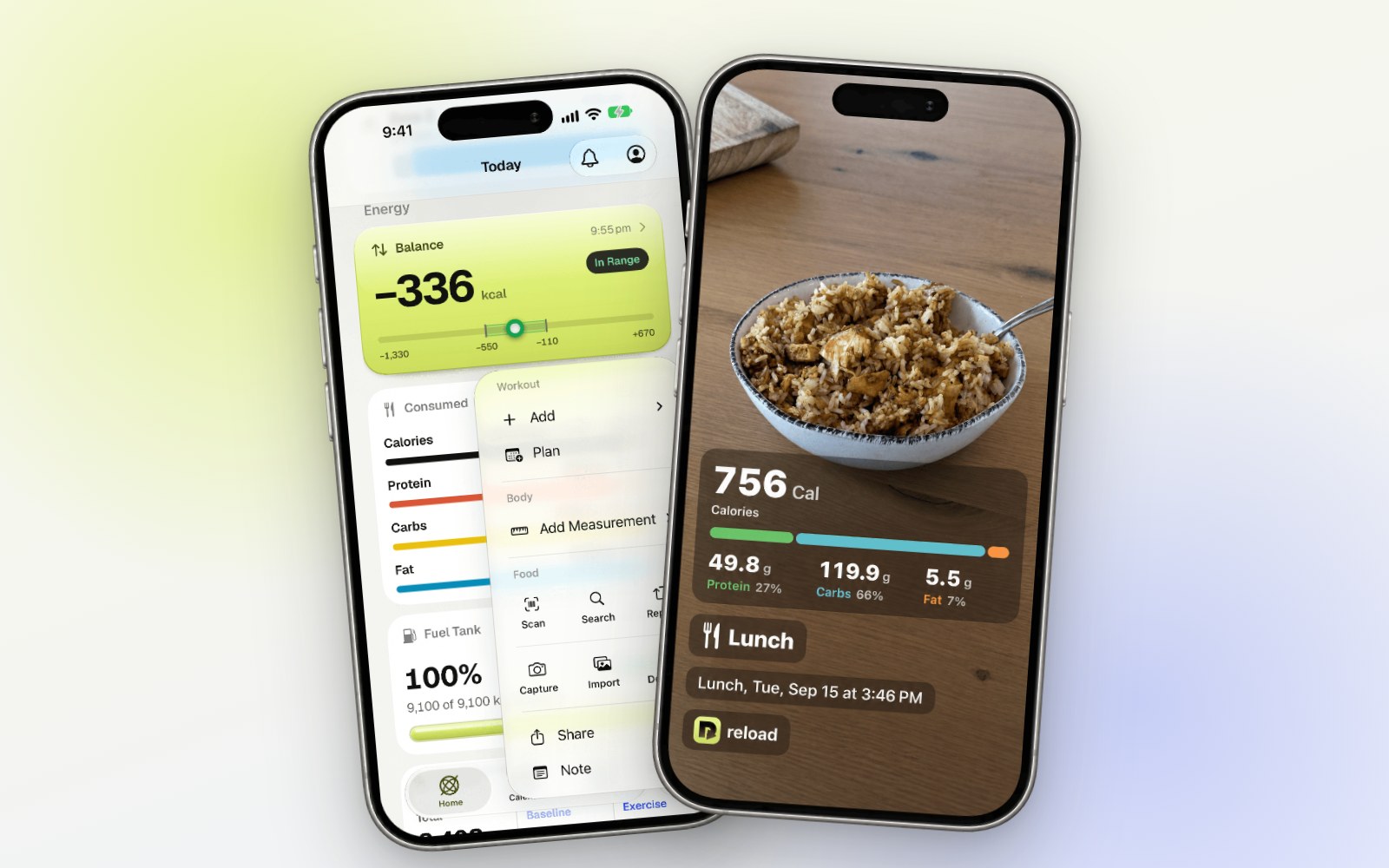
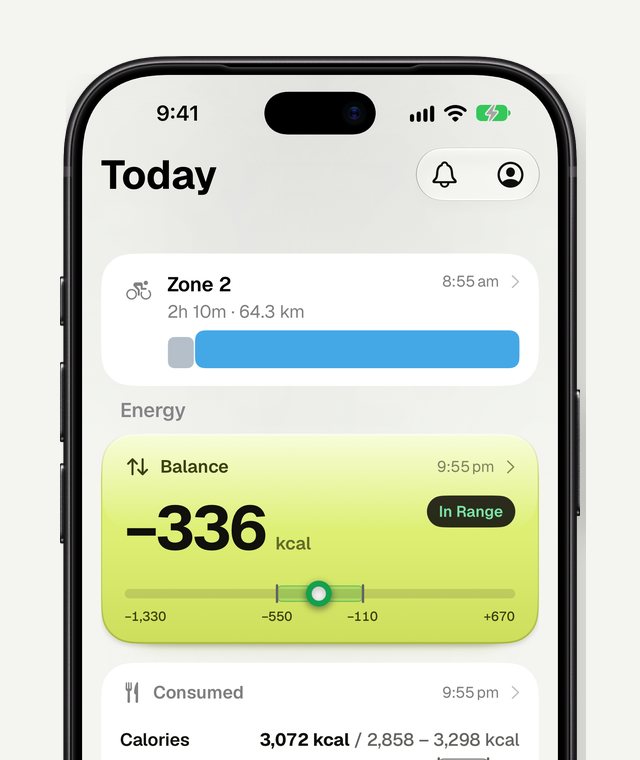
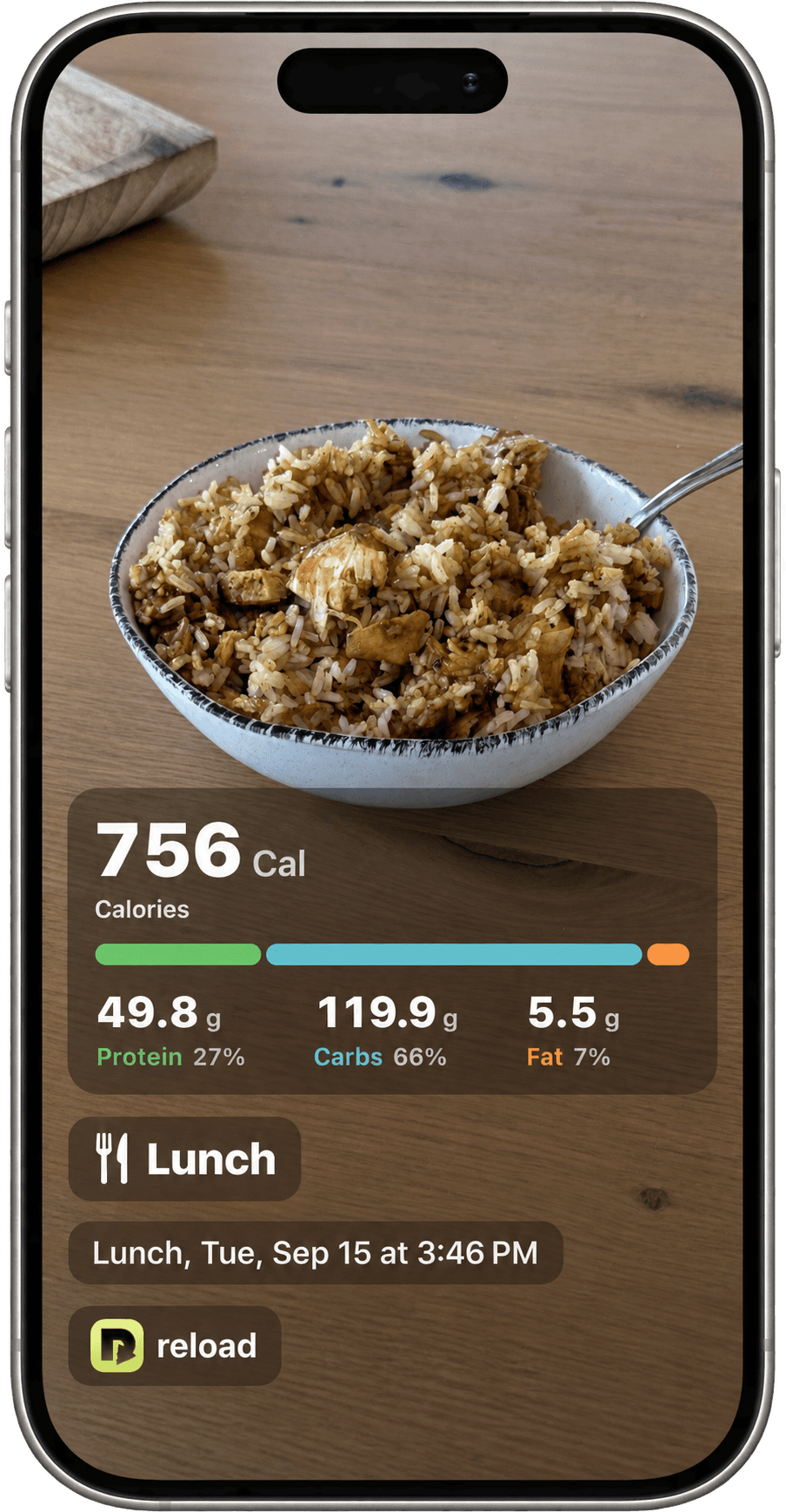
reload is a calorie and macro tracker built for endurance athletes, so the food log and the training data sit in one app. It connects to WHOOP and reads the training you have completed and the training you have planned. From that, it sets daily calorie, protein, carbohydrate and fat targets, so a long ride day and a rest day get different targets. Protein, carbs and fat each get a target range rather than a single number, and the app shows how each day’s targets were built. Energy burned is split into resting and active. Log food by search or barcode scan. reload Max turns a photo or a short description into calories, protein, carbs and fat, and shows every portion so you can adjust it before saving. reload is available on iPhone. See plans.




FAQ
Can WHOOP count the calories I eat?
The WHOOP pages we checked do not describe a built-in food database or barcode scanner. WHOOP can auto-fill some nutrition data into the Journal from Apple Health, and the Journal includes a calories behavior [1].
Does WHOOP sync with nutrition apps?
On iPhone, WHOOP reads some macronutrient and micronutrient data from Apple Health into the Journal [1]. WHOOP also documents an integration that sends WHOOP data to Cronometer [2].
How accurate is WHOOP calorie burn?
WHOOP describes its numbers as estimates [3]. We found no peer-reviewed WHOOP validation in PubMed, and reviews of other wrist-worn devices report errors of roughly 10% to 40% or more [7][8].
Does WHOOP give me a daily calorie intake target?
The WHOOP pages we checked do not describe a daily calorie intake target. WHOOP shows calories burned and lets you track behaviors against Recovery [1][3][4].
Scientific references and sources13 sources, cited in the text as [1], [2] and so on
- 1WHOOP, Inc., n.d., Celebrating the products and features we launched in 2023, WHOOP The Locker, whoop.com/thelocker/celebrating-the-products-and-features-we-launched-in-2023 (checked 29 October 2026)
- 2WHOOP, Inc., n.d., Cronometer Integration, WHOOP Support, support.whoop.com/APP_FEATURES__COACHING/App_Integrations/Cronometer_Integration (checked 29 October 2026)
- 3Capodilupo E, n.d., Calorie Tracking Explained: BMR, Burn, and Accuracy, WHOOP The Locker, whoop.com/thelocker/calorie-tracking-science/ (checked 29 October 2026)
- 4WHOOP, Inc., 2026, 2026 What's New at WHOOP, WHOOP The Locker, whoop.com/us/en/thelocker/2026-whats-new/ (checked 29 October 2026)
- 5Apple Inc., 2026, Manage Health data on your iPhone, iPad, or Apple Watch, Apple Support, support.apple.com/108779 (checked 29 October 2026)
- 6Keytel LR, Goedecke JH, Noakes TD, et al., 2005, Prediction of energy expenditure from heart rate monitoring during submaximal exercise, Journal of Sports Sciences, doi.org/10.1080/02640410470001730089
- 7Hogue T, Khoury A, Njeim P, et al., 2026, Advancement in wrist worn physical activity trackers: technological developments and measurement accuracy: a systematic review, Frontiers in Digital Health, doi.org/10.3389/fdgth.2026.1820224
- 8Germini F, Noronha N, Borg Debono V, et al., 2022, Accuracy and acceptability of wrist-wearable activity-tracking devices: systematic review of the literature, Journal of Medical Internet Research, doi.org/10.2196/30791
- 9O'Driscoll R, Turicchi J, Beaulieu K, et al., 2020, How well do activity monitors estimate energy expenditure? A systematic review and meta-analysis of the validity of current technologies, British Journal of Sports Medicine, doi.org/10.1136/bjsports-2018-099643
- 10O'Neill JER, Corish CA, Horner K, 2023, Accuracy of resting metabolic rate prediction equations in athletes: a systematic review with meta-analysis, Sports Medicine, doi.org/10.1007/s40279-023-01896-z
- 11Hopker JG, Jobson SA, Gregson HC, et al., 2012, Reliability of cycling gross efficiency using the Douglas bag method, Medicine and Science in Sports and Exercise, doi.org/10.1249/MSS.0b013e31822cb0d2
- 12Ettema G, Lorås HW, 2009, Efficiency in cycling: a review, European Journal of Applied Physiology, doi.org/10.1007/s00421-009-1008-7
- 13National Institute of Standards and Technology, n.d., NIST Guide to the SI, Appendix B.8: Factors for Units Listed Alphabetically, NIST, nist.gov/node/777676

Live now on iPhone.
Choose your plan, check out on the web and get reload on your iPhone today. Android is coming to Google Play next, so join the Android list and you’ll be the first to know when it lands.

